Budget
In 4grosze (even though the application is divided into months), we actually create not a monthly budget, but a continuous one. Continuous means that if you put 500 EUR into an envelope today, that 500 EUR will stay there until you spend it, even if it's in six months or a year. Similarly, if you record a salary today, that amount will be available in To be allocated until you distribute it to envelopes, even several months later. This rollover mechanism makes the budget in 4grosze work differently than in many other budgeting applications, but it's also very accurate (down to the penny), allows you to save for different things, and plan several months ahead.
What is monthly, however, is the cycle of adding to envelopes - each month you can add some amount to an envelope, thereby increasing its contents. For example, if you add 1000 EUR to one envelope every month, after a year in just that one envelope (provided you don't spend anything from it) you'll accumulate 12,000 EUR. This is a very good way to save for larger expenses.
Automatic rollover of unused amounts
Money that we don't use in a given month automatically carries over to the next month. For example, if in September we put 1200 EUR into the Food envelope and spent 950 EUR by the end of the month, then 250 EUR will be carried over to October. Understanding this rollover mechanism is quite important for effective budget management in 4grosze, while it also allows for a fairly flexible approach to planning.
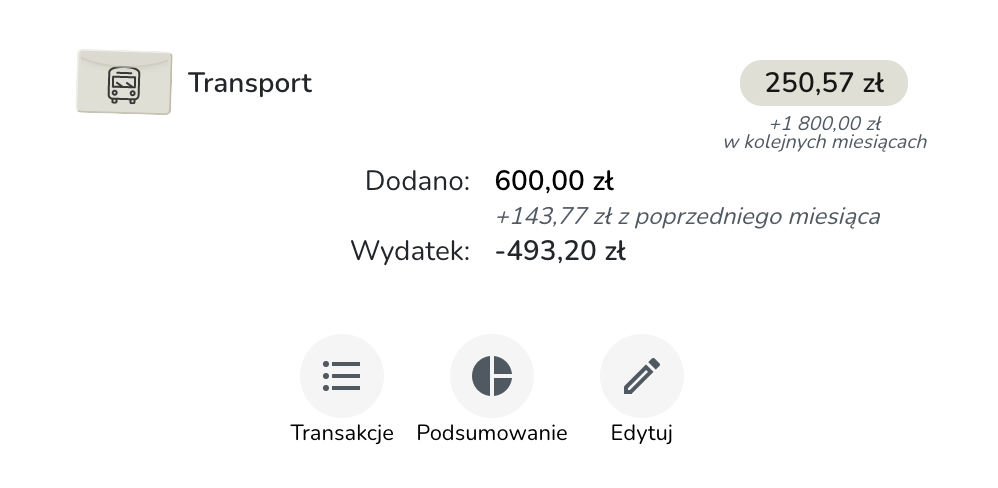
The most important parameters for a given envelope are available in the envelope summary view. We can read how much money we have left until the end of the month, how much is allocated in future months, how much was carried over from the previous one, etc.:
"To be allocated" amount
At the top of the budgeting screen, you'll find a special envelope called To be allocated. All your income goes into this envelope. It's worth noting here that the To be allocated envelope is independent of the currently selected month, whereas spending envelopes are not. This means that switching between months has no effect on the value of this envelope. Thanks to this, money you receive this month can be added to envelopes in any month.
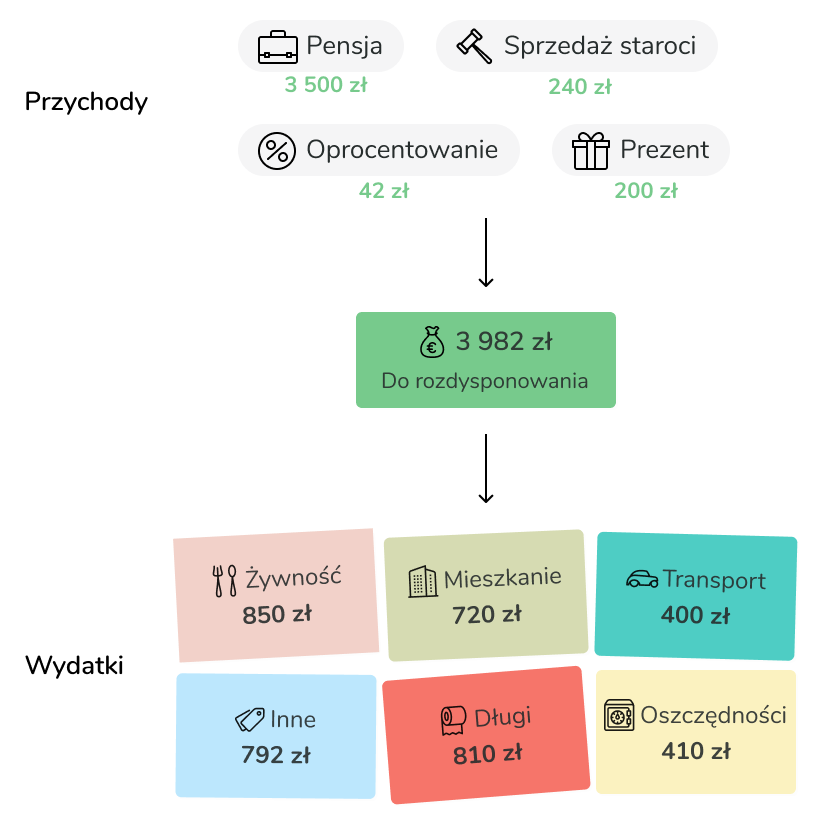
We allocate money we already have, not money we will soon receive
This is a very important principle. In many household budgeting methods, planning starts with writing down the expected income for a given month, then the calculated amount is distributed to individual expense categories. Even with a regular salary, there are small differences - you might get a bonus, earn something extra after hours, or find a few pennies on the street. Moreover, in some professions, income is so irregular that it would be really difficult to estimate how much we'll earn in a given month. This is solved in various ways - averaging earnings from the last few months, or using the most optimistic or most pessimistic variant. In each of these variants, we're talking about an approximate income amount, which may be close to reality, but will rarely be exact.
However, perhaps the biggest disadvantage of planning a budget based on estimated income is that the money we expect may never arrive in the account. And for a thousand different reasons. Illness, job loss, lack of clients, etc. And 2020 has already clearly shown that from one day to the next you can be deprived of the ability to earn, and for many months. And then what? Even though in the Food category you see 800 EUR, it may be a value without coverage.
On the other hand, the envelope method used in 4grosze works with penny precision, because it allows us to allocate only the money we have at a given moment. If today we received 5000 EUR, only then and only that much can we put into envelopes. It's worth imagining cash and physical envelopes here - you won't add money to an envelope that you don't actually hold in your hand (well, unless you take a newspaper and cut out banknotes from it with a note like available from the 15th 😋).
Thanks to this simple principle, when you look into an envelope and see 400 EUR there, you're certain that this 400 EUR is available immediately. Moreover, it solves the problem of estimating irregular payments. You receive money, record it, and only then distribute it to envelopes. Simple.
Planning ahead
Many people plan their budget from paycheck to paycheck, but in 4grosze we encourage planning your budget ahead of time, even several months in advance. The money we earn in a given month doesn't necessarily have to go into envelopes for that month, but can be used to plan one of the future months. Initially, this may be difficult to implement, but over time we'll have an increasingly longer period budgeted.
It's worth remembering here that money from one paycheck can be put into envelopes from several different months. For example, if today is the 10th day of the month and we received our salary today, we can allocate 10% of the received amount to fill gaps for the current month, 70% will be allocated to budget the next month, and the remaining 20% will be allocated to plan part of the key expenses for yet another month ahead.
Of course, there's also nothing preventing you from "packing" 100% of your salary into envelopes in a given month and relying in that case on the function of automatic rollover of unused amounts to the next month. It's worth experimenting here and checking what works better or worse.
How often to allocate money?
You can adopt two variants:
As soon as any money comes in, we distribute it to envelopes the same day or the next day. Regardless of source or amount. So, for example, if the salary came in today, I do an envelope allocation session in the evening. Or I found 10 EUR on the street and immediately add that 10 EUR to one of the envelopes.
You can set one day in the month by which most of the planned money will already be in our accounts. Let's say the 20th of each month. On that day, we distribute the money from To be allocated.
Of course, you can mix these variants or use others. It's worth reminding once again that we can allocate received money in any month - part can go to fill gaps in the current one, part to plan future months.
Moving money between envelopes
During the month, we can freely move money between envelopes (and even months). Sometimes this is even necessary, because nothing can be 100% planned and suddenly an unexpected expense appears that we hadn't even thought of before. Because if we've already allocated all the money earlier, then to fill gaps in an envelope, we must simply take money out of another envelope. Well, money doesn't grow on trees.
Collecting leftovers at the end of the month
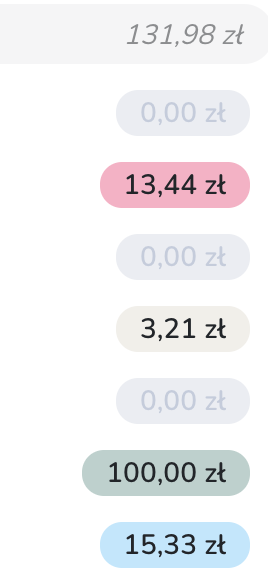
Very often on the last day of the month, some small amounts will remain in some envelopes. You can leave these amounts as they are (they will be automatically carried over to the next month), but you can also move them back to To be allocated. Thanks to this, even though we didn't receive new money, a certain amount will accumulate again, which we can more consciously distribute in the next month or move to savings.
To quickly move money from envelope to envelope, or back to To be allocated, use the Drag and drop function. In the web version, simply grab the amount field and drag it to another. In the mobile version in the envelope view, long-press an envelope and move it to another.
You can also use mathematical operations plus and minus to quickly withdraw specific amounts from envelopes.